A solo company, coordinated by AI agents
An experimental platform for a solo founder to coordinate enquiries, quotes, delivery, support and finance. AI agents prepare and route work through shared records and approval steps, so customer commitments do not depend on copying information between disconnected tools. Original internal R&D; work in progress.
Experimental · Work in progress · Original internal R&D. This is a platform commissioned internally at Kuzushi Labs to explore a practical question: how much of a small company's routine coordination can be delegated to AI while the founder retains control of commitments, money and exceptions?
A customer enquiry should become a qualified opportunity, a reviewed quote, agreed delivery work and an invoice supported by completion evidence. If a complaint arrives later, the original scope and delivery history should be available immediately. Today, much of that coordination happens in the founder's head, across an inbox, spreadsheets and separate business tools. The platform is being built to keep those steps connected and bring unresolved decisions back with the information needed to act.
Read the 40-part engineering series · Download the articles, diagrams and Python lab
The core idea: close the loop around a business promise
The design starts with business records and permitted state changes. An agent can interpret an enquiry, draft a proposal or recommend a response. A shared action dispatcher checks whether the requested change is allowed and whether it needs approval. The outcome becomes a record or event that another loop can act on.
For example, sales does not tell delivery “the conversation went well.” It hands over an accepted scope with a stable identity and a specific version. Delivery retains evidence of completion. Finance can then explain why an invoice is due. This creates an operating history that survives changes to prompts, models and conversations.
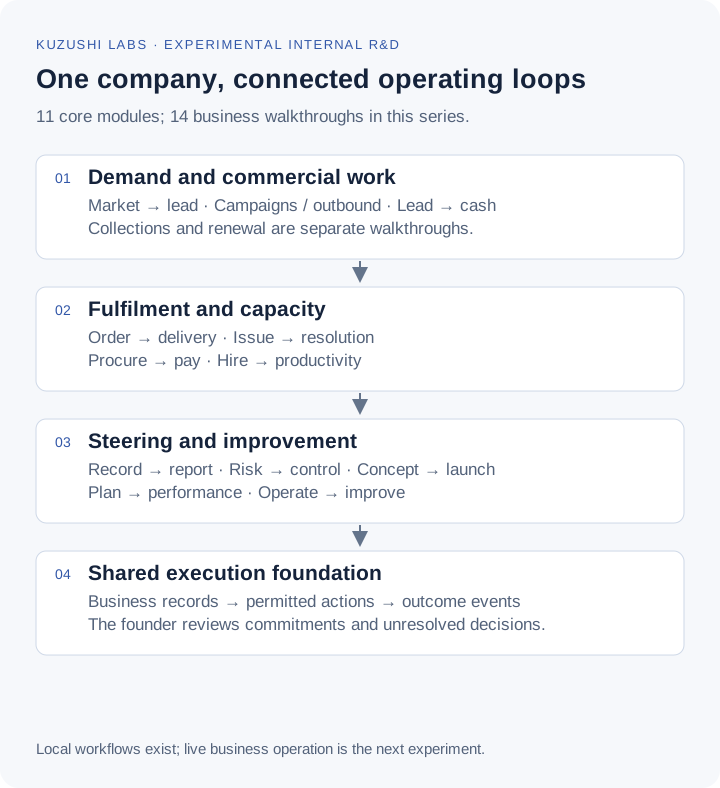
Fourteen business walkthroughs over eleven core loops
The current implementation defines 11 top-level loops. The articles separate campaigns, collections and renewals into three additional walkthroughs because they are distinct jobs for a founder. They remain sub-loops in the architecture.
| Work to coordinate | Loops and walkthroughs |
|---|---|
| Find and win business | Market-to-lead; campaigns and outbound; lead-to-cash |
| Collect and retain revenue | Invoice-to-cash; retention and renewal |
| Deliver and support | Order-to-delivery; issue-to-resolution |
| Acquire capacity | Procure-to-pay; hire-to-productivity |
| Understand and steer the company | Record-to-report; risk-to-control; concept-to-launch; plan-to-performance |
| Improve the agents | Operate-to-improve |
The walkthroughs use a fictional software studio to make decisions concrete: a document-search pilot, a reviewed commercial scope, delivery evidence, partial payment and a support exception. They show the records, rules and handoffs involved, rather than describing a collection of chatbots.
The agent harness sits above the operating rules
An AgentRuntime interface separates reasoning from effects. Most current loop agents are deterministic. A Pydantic AI adapter demonstrates a governed lead-creation tool, while a gateway-oriented harness handles routed model calls and single-shot execution.
The next layer is a bounded orchestrator that assembles context and tools for the task in front of it. A quote episode gets the customer record, relevant scope and commercial actions; it does not need authority to transfer funds. Step and cost limits, checkpoints, approval resumption and correlation across loops belong in that shared lifecycle. Consolidating the two existing execution surfaces is part of the current R&D roadmap.
Connectors have a specific responsibility
Email and web-form adapters turn supplied payloads into typed interactions. CRM, advertising and outbound email adapters currently simulate external effects. The next implementation adds authenticated transports, cursor recovery, scoped credentials, provider receipts and reconciliation.
This boundary matters. Drafting an email, approving it, sending it and confirming its delivery are separate facts. A failed network request may leave the outcome unknown; it should not cause a second commercial action to be created blindly.
What works today, and what is still being built
| Area | Current evidence | Remaining work |
|---|---|---|
| Business workflows | Local loop implementations, typed contracts and state transitions | Restricted real-world trial across a complete customer journey |
| Agent execution | Deterministic adapters and a narrow model-backed adapter | General bounded orchestration and on-demand tool composition |
| Governance | Role checks, policy port, review queue and local idempotency | Authenticated identity, durable operation records and fresh checks when approval resumes |
| External systems | Supplied inbound payloads and simulated outbound adapters | Live integrations and provider reconciliation |
| Operator interface | FastAPI inspection and human-review routes | A secured founder cockpit with consistently scoped access |
| Evaluation | 303 local tests passed, 2 skipped during this review | Real model-quality evaluation and measured supervision burden |
The local test result is useful regression evidence. It is not a claim of production uptime or a business running unattended. The public reading kit includes a new company lab with 62 passing tests for state, leases, receipts, scoped execution and business rules, plus the original 18-check lab for approvals, replay, isolation, partial settlement and cost arithmetic.
The first useful milestone
The initial live milestone is one enquiry reaching a reviewable quote, with source evidence intact and no duplicate records or hidden commitments. Delivery, billing and support can follow once that operation can resume safely after failures.
The business measure will be completed work and founder supervision time, including corrections and recovery. There is no claimed revenue uplift or saved headcount at this stage. The project is an experiment in making the operating work of a small company explicit enough to delegate and supervise.
Explore the engineering
The 40 articles cover shared memory, controlled actions, a custom harness, connector contracts, every business walkthrough, event coordination, economics, evaluation and deployment. Forty-seven diagrams illustrate the architecture and practical failure scenarios. The downloadable kit includes a new company lab with 62 tests and the original 18-check lab. Readers can inspect versioned state, worker leases, scoped tools, uncertain receipts and partial settlement without external accounts. Additional chapters cover live connector design, AWS/GCP deployment, security, Polsia and related research.
My contribution
This is an original project I commissioned for my own work at Kuzushi Labs. My role combines defining the business loops, shaping the shared architecture and action contracts, hands-on development and evaluation, and deciding which parts are ready for a restricted trial. The current focus is turning the local foundation into one dependable operating journey before expanding its autonomy.
Technical Stack
| Layer | Technology |
|---|---|
| Runtime | Python, Pydantic, Deterministic loop agents, Pydantic AI adapter |
| Business model | Typed objects and links, State machines, Version history, Action and event contracts |
| Control | Action dispatcher, Approval queue, OPA policy gateway, Cost/value ledger |
| Local infrastructure | FastAPI, SQLite, In-memory adapters, Docker Compose |
| Connector prototypes | Email and web-form ingestion, CRM projection, Campaign and outbound simulations |
How engagements like this are scoped and delivered: How I Work.