Part 36 of 40 · 5 min read
Polsia and the systems around the autonomous-company idea
Experimental · Work in progress · Internal R&D
What comparable products and frameworks contribute, and how I would evaluate them for a solo operating platform.
Arunank Sharan · Kuzushi Labs ·
In this article
Polsia is a useful comparison because it presents the ambition in business language: an AI system that helps run a company across several functions. That is closer to the problem I am exploring than a standalone chatbot that answers questions about company documents.
The comparison becomes more useful when we separate product scope from implementation evidence. A polished demo can show an agent shipping code or drafting outreach. Operating a business also requires knowing what was authorised, what actually happened, how much it cost and what remains unresolved.
What Polsia contributes to the discussion
Polsia's public site describes planning, building, marketing and customer-facing work across a company. Its founder's account describes agents operating in loops and connecting to external tools. Those are relevant product ideas for a solo founder: ongoing work, shared context and action across systems. The public pages do not establish the internal transaction, approval or recovery design, so I would test those behaviours rather than infer them from the positioning. Polsia, founder's account.
My project is an experimental internal R&D platform organised around business objects and loops. It is not a claim to have reproduced Polsia's product or matched its operating results. The useful comparison is which responsibilities each system makes explicit and what evidence a founder can inspect.
Different tools occupy different layers
| System or pattern | Useful contribution | What the business platform must still own |
|---|---|---|
| Polsia | Company-level product ambition and connected execution | Validate fit, controls and outcomes in a pilot |
| n8n | Connector-rich workflow orchestration | Business state, permissions and effect semantics |
| LangGraph | Persisted graph execution and resumable agent state | Commercial commitments and domain approval |
| CrewAI Flows | Explicit flow structure around agent work | Data authority, receipts and evaluation |
| OpenClaw | Gateway and channel-oriented agent architecture | Business-specific action policy and records |
| Hermes | Reusable skill-oriented agent work | Scoped authority and controlled promotion of learning |
| Temporal | Durable workflow execution across failures and waits | Domain decisions, tool access and customer commitments |
These are not interchangeable “autonomous company” products. The table describes where I would consider a component, not a ranking of vendors.
n8n's queue mode separates workflow execution into workers using queue infrastructure. LangGraph persists execution through checkpoints. CrewAI documents flows for controlling application execution around agents. Those mechanisms can support a business platform, but the company's invoice and approval semantics still need explicit design. n8n queue mode, LangGraph persistence, CrewAI Flows.
Patterns I would borrow carefully
A gateway can give the founder one place to reach agents through different channels. OpenClaw's architecture is relevant to that entry-point pattern. In this platform, the gateway should pass authenticated task context into domain actions rather than become a second source of business truth. OpenClaw architecture.
Reusable procedures reduce repeated setup. Hermes' skills documentation is relevant to packaging that procedural knowledge. A skill can describe how to prepare an invoice reconciliation; it should not grant payment authority or silently change approval policy. Hermes skills.
Durable workflows are useful for waiting on a customer reply or recovering a failed task. The domain action remains the place that checks whether a promise may be made now. Combining these layers is more precise than expecting one agent framework to supply an entire operating model.
Compare with a fixed scenario
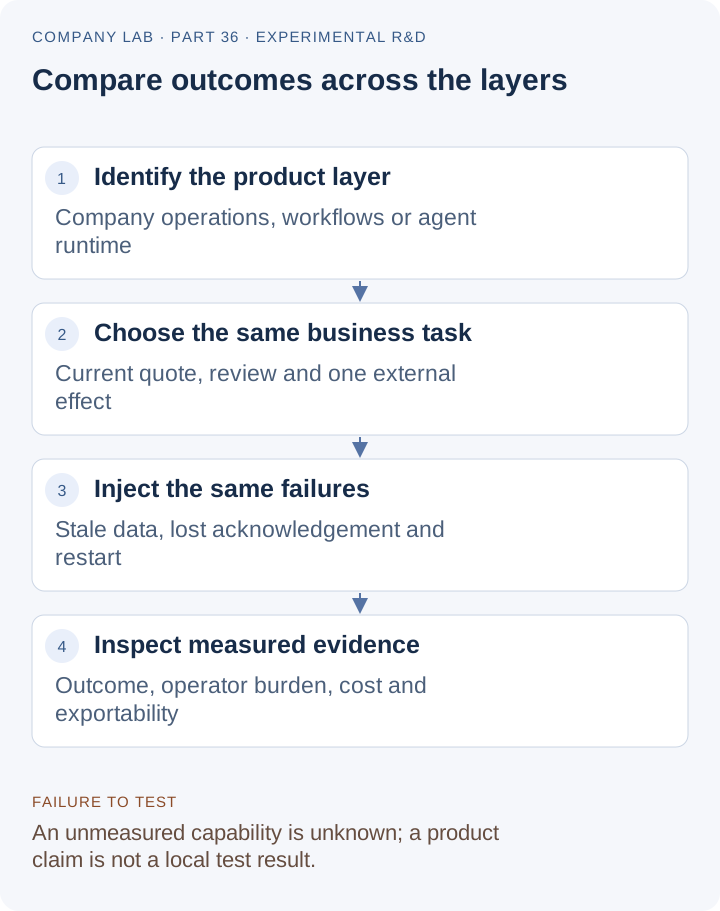
I would give every candidate the same bounded task: receive an enquiry, retrieve the current scope, prepare a quote, wait for review and dispatch it. Then change the quote before approval and lose the provider acknowledgement after dispatch. Ask the system to recover without sending old terms or duplicating the email.
comparison_case:
  name: reviewed_quote_with_restart
  business_outcome: one_current_quote_delivered
  injected_failures:
    - quote_changes_during_review
    - provider_accepts_then_times_out
    - worker_restarts
  required_evidence:
    - reviewed_revision
    - current_authority_check
    - provider_receipt
  forbidden:
    - send_stale_quote
    - duplicate_external_effect
This scenario is a proposed comparison protocol. No vendor results are claimed here. Running it with a product's supported controls would reveal more than comparing landing-page feature lists.
Ask about the operator's actual workload
How many decisions must the founder review? Can the system explain why a task is blocked? Can the founder pause one connector without stopping read-only diagnosis? Does the tool show uncertain effects distinctly from failures? Can records and evidence be exported in a usable form?
For a solo business, these questions affect whether the product saves time. An agent that produces many drafts but requires constant supervision may still help, but the value is different from unattended operations.
Record measured setup time, accepted-task rate, review minutes, unresolved exceptions and complete cost. Use the same task boundaries for the manual baseline. A product's general autonomy claim should not be substituted for those local observations.
Keep the evaluation sheet simple
candidate = {
    "name": "candidate-under-test",
    "task_completed": False,
    "stale_action_blocked": None,
    "duplicate_effects": None,
    "review_minutes": None,
    "cost_minor": None,
    "evidence_exported": False,
}
assert candidate["duplicate_effects"] is None
None means unmeasured, not zero. Fill the sheet from observed runs and preserve failures. Add notes about account permissions, provider integrations and configuration because those conditions can change the result materially.
The conclusion I want from this comparison is practical: which parts should be bought, which can be assembled from existing frameworks, and which business contracts need to remain explicit in the platform. The objective is a dependable operating system for one small company, not a claim that every function has become autonomous because several agents share a chat channel.