Part 18 of 18 · 5 min read
Run the lab and ship one workflow
Run the local example, reproduce failures and follow a staged implementation handoff.
Arunank Sharan · Kuzushi Labs ·
In this article
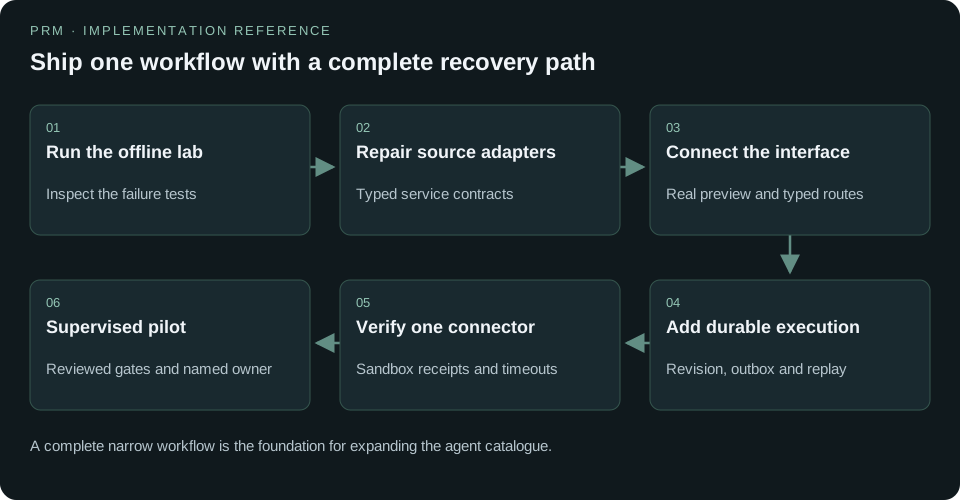
I would begin the next implementation phase with one complete administrative workflow: select a verified patient, prepare a slot, review it, book it once and open the resulting appointment. Then attach a separately observable communication step. A small complete path exposes more engineering truth than a large agent catalogue.
The downloadable reference lab was written for this expanded series. It uses Python's standard library and SQLite, runs locally and contains synthetic identifiers. It does not call a model, EHR, messaging service or patient system. Its purpose is to make the action boundary and failure cases executable.
Run it before reading every chapter
Download and unzip the implementation kit, then enter its reference-lab directory:
python3 --version
python3 prm_lab.py
python3 -m unittest discover -s tests -v
Use Python 3.10 or later with an IANA time-zone database available to zoneinfo. The demo creates a temporary database and removes it when finished. You should see one appointment, one outbox event and one provider receipt. UUIDs will differ across runs.
Understand the files and boundaries
| Artifact | What it demonstrates | What it does not claim |
|---|---|---|
prm_lab.py | Proposals, revisions, idempotency, booking transaction, outbox leases | A production web service |
tests/test_workflows.py | Races, rollback, expiry, authorization, callbacks, time zones | Live connector compatibility |
benchmark/scenarios.jsonl | 24 starter scenario cards across 12 families | A completed model benchmark |
benchmark/README.md | Proposed 300-case evaluation and reporting contract | Clinical validation |
connectors/ | Example protocol and resource contracts | Deployed MCP, A2A or EHR servers |
frontend/ | A typed destination and latest-response helper | A replacement dashboard |
The article snippets marked as SQL sketches or interface pseudocode require adaptation. The kit identifies those separately from the runnable Python example. That keeps “copy and run” distinct from “use this contract while integrating.”
Reproduce the approval edit bug class
The first experiment is to prepare one slot, edit the proposal and try confirming the old revision:
proposal = lab.propose(actor, "p-001", "s-001", now=100)
revised = lab.revise(
    actor, proposal["proposal_id"],
    expected_revision=1, slot="s-002", now=105,
)

# This must raise Conflict("stale_approval"):
lab.confirm(
    actor, proposal["proposal_id"], 1,
    proposal["plan_hash"], "old-click", now=110,
)
After catching that expected error, confirm revised with its new revision and hash. The appointment must use s-002. The test suite automates both cases. This directly addresses the original implementation seam where edited action parameters and saved execution steps can differ.
Reproduce a lost response
Run a successful confirmation, discard its returned value and call it again with the same idempotency key. The result should identify the same appointment, and the appointment count should stay at one.
Then repeat with a different proposal under the same key. That must fail. An idempotency record is not a generic permission to reuse a cached success; it binds a request fingerprint to a result.
For delivery, the fake provider can accept a message and then raise a timeout. Repeating the request with its stable event ID returns the same fake receipt. This connector intentionally supports idempotency. A real provider needs its own documented facility or a reconciliation path; the fake is not evidence that every provider is safe to retry.
Give the developer a sequence of deliverables
I would implement the integration in five bounded stages. The durations below are planning windows for a small experienced team, not promises about an unfamiliar EHR procurement or security review.
| Stage | Deliverable | Exit evidence |
|---|---|---|
| Days 1–3: source contracts | Repair patient and appointment tool adapters; normalize results | Service contract tests pass without a model |
| Days 4–7: one UI path | Backend interpretation, editable proposal, confirmation, typed route | Browser test reaches one persisted appointment |
| Days 8–12: durability | Versioned proposals, idempotency, outbox, restart recovery | Crash and duplicate-event tests pass |
| Days 13–17: one connector | Vendor sandbox booking or one messaging channel, receipts and reconciliation | Contract fixtures and recorded sandbox outcomes |
| Days 18–20: supervised pilot gate | Reviewed scenarios, telemetry, rollback and staff handoff | Agreed release gates and named incident owner |
If the connector contract is unresolved, keep progressing on synthetic fixtures but do not label the integration complete. A vendor's authentication, supported resource profile or booking semantics can change the implementation effort substantially.
Map the work back to the original project
The backend adapter work belongs around the existing orchestrator registry and domain services. The confirmation changes belong in pending-action storage and execution reconstruction. The frontend work replaces the command-bar simulation with the backend contract and connects result cards to allowed routes.
Journey transitions need durable event creation and worker recovery. Provider integration needs one verified path from a communication record to a real receipt. Session context needs explicit use in the agent execution path, and dashboard updates need an actual authenticated subscription rather than a declared provider with its connection disabled.
I would track each of those as an acceptance story with a before/after trace. “Added MCP” or “enabled memory” is too broad to tell a reviewer what became dependable.
Run the release drill with the team
Before the pilot, have one person act as coordinator, one as patient-role simulator and one as operator. Prepare a booking, change the date, deny an old approval, confirm the new proposal, interrupt the worker and recover the result. Then revoke the coordinator's permission and verify that a replay does not disclose or execute the operation.
Finally, create an unresolved connector outcome and hand it to the designated operator. The operator should be able to find the request, determine what remains unknown and reconcile it without reading an entire chat transcript. If that requires developer guesswork, the recovery surface is not finished.
The point of this implementation path is a narrow, demonstrable result. Once one workflow survives corrections, retries, restarts and handoffs, extending the platform becomes a matter of adding well-defined operations to a working foundation.