Part 17 of 18 · 6 min read
What Polsia and agent research change
A sourced comparison with Polsia and Hippocratic AI, plus five research-driven experiments.
Arunank Sharan · Kuzushi Labs ·
In this article
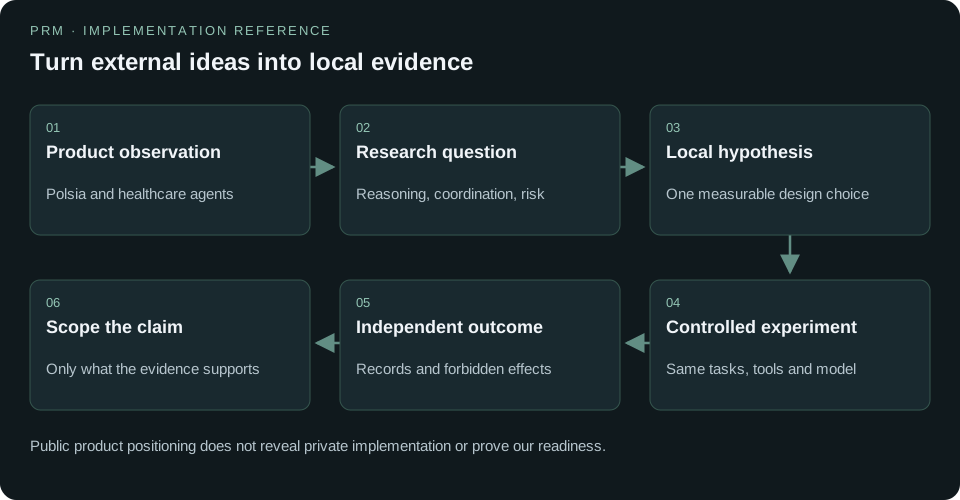
I look at other agent products for operating ideas, then ask which of those ideas survive contact with our workflow. A company-running agent and a patient relationship platform can both coordinate tasks, tools and persistent context. They have different authority boundaries, failure costs and evidence requirements.
Polsia is a useful comparison at the level of continuous business execution. Healthcare-focused products provide a closer comparison for outreach and coordination. Research benchmarks help define what we should measure. None of those sources establishes what our own code has completed.
What I would take from Polsia
In its own business automation article, Polsia describes coordinating planning, product development, marketing and operations through an AI operating layer. I treat that as the company's public positioning. I have not audited its private runtime, production controls or healthcare suitability.
The useful analogy is persistent work across functions. In PRM, an appointment, communication and staff task should form one visible chain with owners and outcomes. The transfer is the operating pattern: keep a backlog, schedule work, preserve context and surface exceptions. It is not a claim that broad company autonomy can be copied into patient workflows unchanged.
I would also avoid using similarly named community projects as evidence of Polsia's implementation. A public clone can illustrate an architecture, but it cannot establish the original company's model choices, isolation design or delivery guarantees.
Compare products on decisions, not adjectives
Hippocratic AI's patient-calling page describes appointment access, follow-up and outreach use cases with human escalation. That is a closer workflow comparison for a future voice extension. Its published capabilities and performance claims remain the vendor's claims; they are not measurements of our platform.
| Comparison lens | Question I would ask for PRM |
|---|---|
| Continuous business agents such as Polsia | Does work continue after the initiating chat ends? |
| Healthcare outreach agents such as Hippocratic AI | What verifies identity, constrains scope and completes a human handoff? |
| Durable agent frameworks | What state survives a pause, retry or process restart? |
| Tool and agent protocols | Which capabilities can be exposed without expanding authority? |
| Agent benchmarks | Can success be checked against records and repeated reliably? |
The table is my engineering interpretation, not a feature ranking. The products serve different users, and a public marketing page rarely answers the connector-level questions a deployment needs.
Five research ideas that change the implementation
ReAct studies interleaving reasoning and actions. I use that idea to let observations guide the next bounded step: an ambiguous patient search should lead to selection, not a guessed booking. The PRM's deterministic authorization and commit rules remain outside that loop. Read the paper.
τ-bench connects conversational tool use with policy adherence and final state, including reliability across repeated trials. That changes our evaluator: a correct-looking answer is insufficient if the database is wrong. Read the paper.
τ²-bench makes both the user and agent participants in a changing environment. For PRM, that suggests testing a coordinator who changes a selected patient, corrects a field or performs a parallel action through the ordinary UI. Read the paper.
MedAgentBench connects agent tasks to a FHIR-compatible record environment. It suggests using executable fixtures and resource-level outcomes. Our administrative evaluation should remain distinct from its medical task scope. Read the paper.
AgentDojo evaluates prompt injection through tool-returned data. It suggests placing hostile instructions inside otherwise useful policy and message fixtures, then checking both legitimate task completion and forbidden effects. Read the paper.
I would not combine scores from these papers into a PRM readiness score. Their environments, tasks and definitions differ. The useful output is a better local experiment.
Turn an idea into an experiment card
For example, the hypothesis that typed action cards reduce correction errors can be tested without claiming that any external product proves it:
{
  "experiment": "typed-preview-versus-text-preview",
  "hypothesis": "Structured fields improve detection of wrong slot and patient choices",
  "variants": ["text_only", "typed_card_with_field_correction"],
  "shared_conditions": ["same_model", "same_tasks", "same_connector_fixtures"],
  "primary_measure": "incorrect_proposals_confirmed",
  "secondary_measures": ["correction_time", "task_completion", "reviewer_workload"],
  "release_constraint": "no expansion of write permissions"
}
I would randomize task assignment, counterbalance order and distinguish staff training effects from interface effects. The first study can use synthetic administrative cases. A later deployment study needs the organization's review and data-handling process.
Another experiment compares a fixed booking state machine with a free-form multi-agent planner. Keep the model and tools constant, then measure unsupported transitions, repeated calls, recovery after interruption and total task cost. If the fixed workflow performs better, that is a useful result; the portfolio does not need more autonomous agents to be technically interesting.
Ask vendors for the missing evidence
For a serious product evaluation, I would request a worked trace of one successful operation, one denied operation and one timeout after external acceptance. I would ask how identities propagate, how approvals bind to parameters, how repeated requests are deduplicated and how customers recover pending work after an outage.
For a healthcare workflow, I would also ask what the product treats as out of scope, how the human recipient accepts a handoff and how evaluation cases reflect the deployment's languages and local processes. A broad statement about safety or autonomy does not answer those operational questions.
Keep our own narrative to the same standard
The original PRM has domain services, agent orchestration, action cards, pending actions and interface prototypes. The new reference lab adds executable demonstrations of several reliability controls. The proposed connectors and pilot plan describe the next engineering work. Those are three distinct kinds of evidence.
That distinction makes the series more useful to a developer. They can see which ideas came from our build, which mechanisms they can run locally and which claims still need integration tests or field evidence. The implementation kit includes the linked reading map and experiment templates so the research can lead to a concrete change.